
Cell-free bioengineering for gene therapy
Programmable biomanufacturing for gene therapy
Avenyx Bio is developing a cell-free manufacturing platform for viral vectors, beginning with AAV. By moving vector production out of living cells and into an open biochemical system, we aim to make manufacturing programmable, measurable, and rapidly optimizable.
The approach combines plant-derived cell-free biology, advanced molecular analytics, and computational process optimization — the working parts of a cell-free vector foundry.
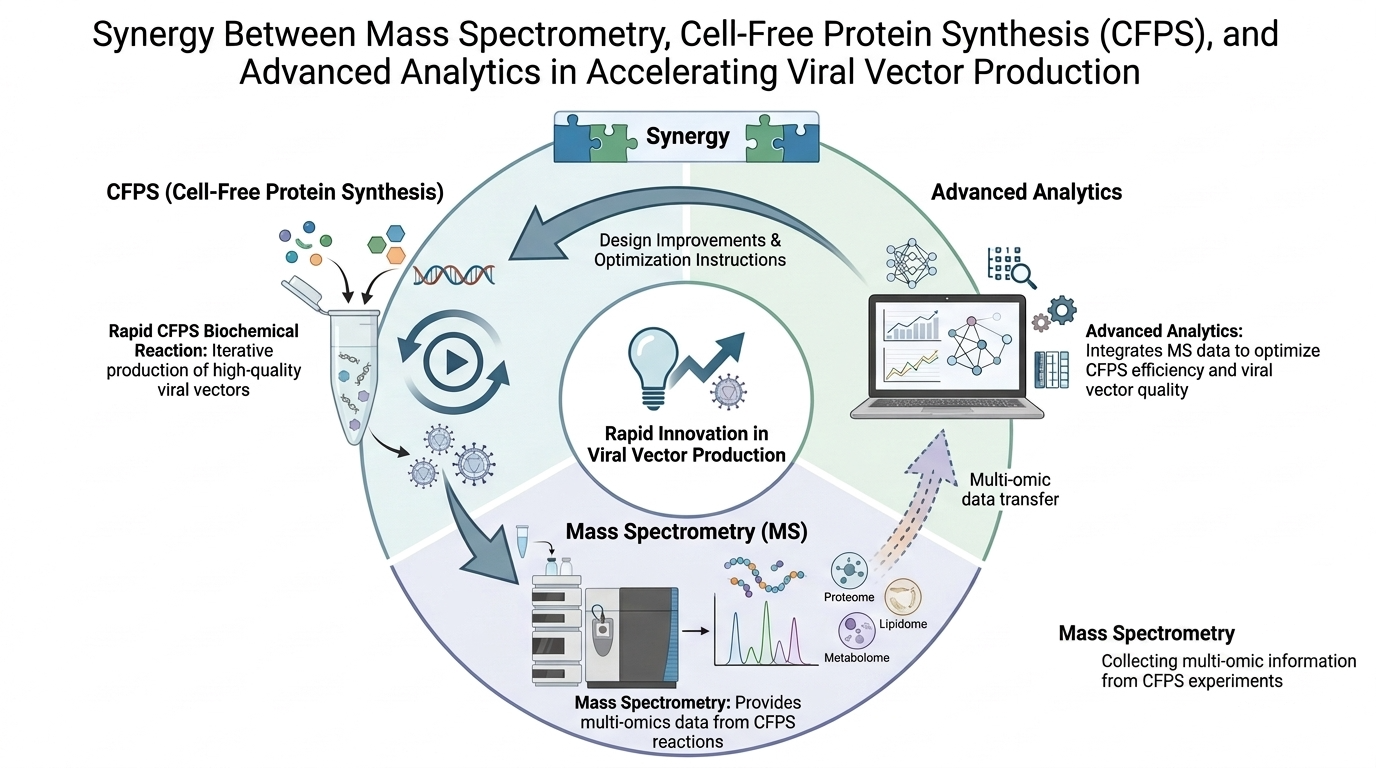
Sequence input
Vector genome and capsid design.
Cell-free system
Plant-derived biochemical machinery in an open reaction.
Vector assembly
Capsid formation and genome packaging.
Characterization
Mass spectrometry and orthogonal methods.
Computational feedback
Reaction data and analytical measurements inform the next design.
The manufacturing gap
Vector design is accelerating. Manufacturing must catch up.
Gene therapies are becoming increasingly sophisticated. New capsids, cargos, regulatory elements, and computational design strategies are expanding what may be therapeutically possible.
Yet viral-vector manufacturing remains strongly dependent on living-cell systems. Complex intracellular biology can make development slow, highly empirical, and difficult to interrogate at the level needed for rapid engineering.
As the number and complexity of engineered vectors increase, manufacturing development itself risks becoming a bottleneck to experimentation, translation, and CMC readiness.
Cell-based production built this field and continues to carry it. The question we are interested in is a different one: whether the next generation of vector designs will eventually ask for a second manufacturing architecture alongside it — one that is open to direct measurement and direct control.
Avenyx Bio is developing that second architecture. We are testing whether moving key elements of vector production outside the living cell produces a development environment that is faster to interrogate and faster to change.
A cell-free approach
From cellular factories to programmable biochemical systems
Cell-free protein synthesis uses the molecular machinery of cells without requiring the cells themselves to remain alive.
An open production environment puts the reaction under direct control: what is present, how much of it, and when it arrives are set rather than inferred — parameters that stay largely out of reach inside a living cell.
Avenyx Bio is developing this concept toward viral-vector production, beginning with the complex challenge of AAV capsid assembly and genome packaging. This is a hard problem, and we treat it as one.
Programmability
The biochemical environment is directly accessible. Component identity, concentration, timing, and reaction conditions are set as inputs, not inherited from a cell.
Observability
An open reaction can be sampled and measured throughout, which is what makes it possible to connect process conditions to the molecular attributes of the resulting vector.
Iteration
Shorter design–build–measure–learn cycles are the objective. Whether cell-free workflows deliver them is precisely what we are building to find out.
Chassis
Why plant-derived cell-free biology?
Complex viral vectors require sophisticated protein-expression and assembly machinery. Plant-derived cell-free systems offer a eukaryotic biochemical environment while retaining the accessibility and programmability of a cell-free reaction.
Avenyx Bio is developing plant-derived cell-free systems as the chassis for AAV production. Whether that chassis carries through to scalable, highly controlled manufacturing is what the work ahead has to establish.
Eukaryotic biology
A eukaryotic folding and processing environment, of the kind complex viral proteins generally require.
Cell-free accessibility
Direct manipulation of the reaction environment, rather than inference from outside a living cell.
Manufacturing potential
Defined, separable components — the starting condition for standardized and modular production workflows.
These are the properties that make the chassis worth investigating. Whether they translate into advantages for AAV production is an open question, and establishing that is the work ahead of us.
First technical objective
Our first challenge: functional AAV outside the cell
The first objective is deliberately ambitious and measurable: establish a cell-free system capable of producing genome-containing, biologically functional AAV.
Development addresses the core elements of vector formation in turn — protein expression, capsid assembly, genome packaging, vector integrity, and biological activity. None of them is solved yet, and each carries real scientific risk.
Long-term vision
Toward a vector foundry
AAV is the starting point, not necessarily the endpoint. If complex viral-vector synthesis can be transferred into programmable cell-free systems, the same principles may ultimately support broader classes of gene-therapy manufacturing.
Our long-term vision is an infrastructure layer where vector designs can move more directly from digital sequence to controlled biochemical production, deep characterization, and iterative optimization.
Vector foundry describes the category we are building toward. It is an aspiration, not a description of anything Avenyx Bio operates today.
Design. Build. Measure. Learn. Manufacture.
A programmable development environment for the next generation of gene therapies.
Collaboration
Building the ecosystem early
Avenyx Bio is at an early stage, and we are interested in conversations with people and organizations working at the intersection of gene therapy, viral-vector biology, cell-free biotechnology, analytical science, and biomanufacturing.
Scientific collaborators
Researchers working in AAV biology, CFPS, plant biotechnology, analytical science, or synthetic biology.
Vector developers
Teams developing novel capsids, payloads, or gene-therapy programs interested in future manufacturing approaches.
Early-stage investors and advisors
People interested in enabling technologies for gene therapy and programmable biomanufacturing.
Incubators and infrastructure
Incubators, accelerators, technology providers, CDMOs, and translational research organizations.
Founder
Founded at the intersection of analytical science and gene therapy
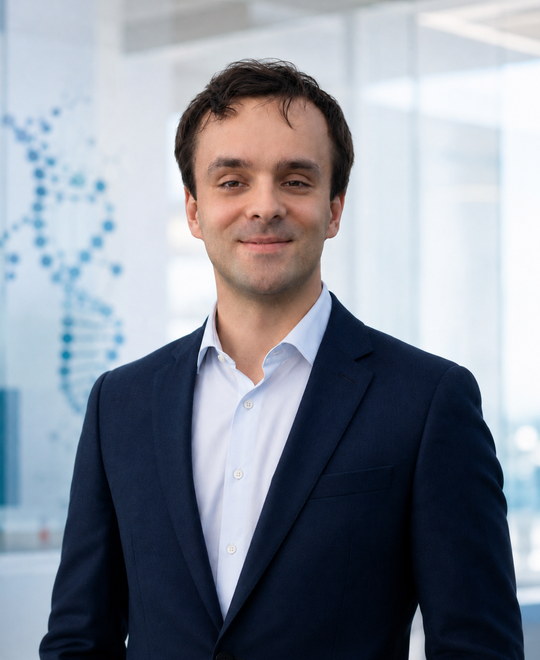
Roman Subbotin, PhD
Founder
Avenyx Bio was founded by Roman Subbotin, PhD, a biopharmaceutical scientist and CMC leader with more than 15 years of experience across advanced mass spectrometry, viral vectors, vaccines, recombinant proteins, and plant-produced biologics. He trained in native mass spectrometry at The Rockefeller University in Brian Chait’s laboratory and has since led analytical development and product-characterization programs for complex biologics and gene-therapy products.
His experience spans the disciplines that converge in Avenyx Bio: plant biotechnology, viral-vector science, CMC development, and high-resolution analytical characterization. That combination underpins Avenyx’s central thesis — that cell-free vector manufacturing can become more programmable, measurable, and ultimately more controllable than conventional production systems.
- PhD, The Rockefeller University — trained in native mass spectrometry and structural characterization of complex protein systems
- 15+ years in biopharmaceutical analytical development across research and GxP environments
- Deep experience in AAV, viral vectors and advanced biologics, including viral vaccines, VLPs and recombinant proteins
- IND CMC leadership — Module 3 authorship, comparability, reference-standard and analytical-control strategies
- Built advanced analytical capabilities spanning mass spectrometry, capillary electrophoresis and multi-attribute methods
- Published scientist with peer-reviewed work in Molecular Cell, PNAS, and Molecular & Cellular Proteomics
Connect
Interested in what we’re building?
We welcome conversations with scientists, collaborators, biotech builders, investors, and organizations thinking about the future of gene-therapy manufacturing.
You can also reach us directly:
- Generalinfo@avenyxbio.com
- Partnershipspartnerships@avenyxbio.com
- Investorsinvestors@avenyxbio.com